
Fibermaxxing with Chia Seeds

Maryellen Hauver • October 9, 2026

Share this article

Nutrition trends come and go… The latest nutrient to come into vogue is fiber. Maybe you’ve heard the trending term “fibermaxxing,” where people are trying to meet or exceed their daily recommended intake for fiber. Honestly, this isn’t the worst trend, because Americans generally don’t meet the recommendation for daily fiber intake. Adults need between 25 and 38 grams of fiber per day, but the average American gets 15 to 17 grams a day.


Fiber is a non-digestible carbohydrate found in plant foods. There are two types of fiber: soluble and insoluble. Soluble fiber dissolves in water and forms a gel-like material as food moves through the gastrointestinal tract, slowing down digestion. It’s good for lowering cholesterol and blood sugar. Insoluble fiber doesn’t dissolve in water, adding bulk to stools and helping with regularity of bowel movements. Fiber can be broken down further into various subtypes, including “fermentable” fiber, which acts as a food source for healthy gut bacteria in our GI tract (also known as a prebiotic). All types of fiber are found in plant foods—mainly fruits, vegetables, whole grains, legumes, nuts, and seeds. Each food within these food groups contains a unique amount of soluble versus insoluble fiber, which is why it is beneficial to eat a variety of foods.


If you want to increase your fiber intake, it’s important to go slowly. Adding too much fiber too quickly can lead to gas, bloating, and cramping. Try gradually increasing fiber intake over the course of a few weeks. This will allow the bacteria in your gut to adjust. It’s also important to drink plenty of water.


You can increase your fiber intake by eating all kinds of plant foods. Chia seeds are one food in particular that is a great source of fiber. Chia seeds are very small, yet they are incredibly nutrient-dense. There are 10 grams of fiber in just 2 tablespoons of chia seeds, in addition to healthy fats, protein, minerals, and antioxidants. Between 85-93% of the fiber in chia seeds is insoluble fiber, while 7-15% is soluble fiber. When chia seeds are soaked in water, the soluble fiber absorbs it, swelling to create “chia mucilage.” That’s the sticky, gooey substance you’ll find surrounding the seeds when they are hydrated.


Incorporating chia seeds into your diet is a small way to get a fiber boost and move closer to meeting the daily recommended intake. Maybe you start with a few teaspoons or tablespoon added to your breakfast, in yogurt, overnight oats, a smoothie, or in a chia pudding. They can be found on campus on the menu at Green Peel. The dry seeds are shelf-stable and can last for years if stored properly, if you’d like to keep your own on hand.


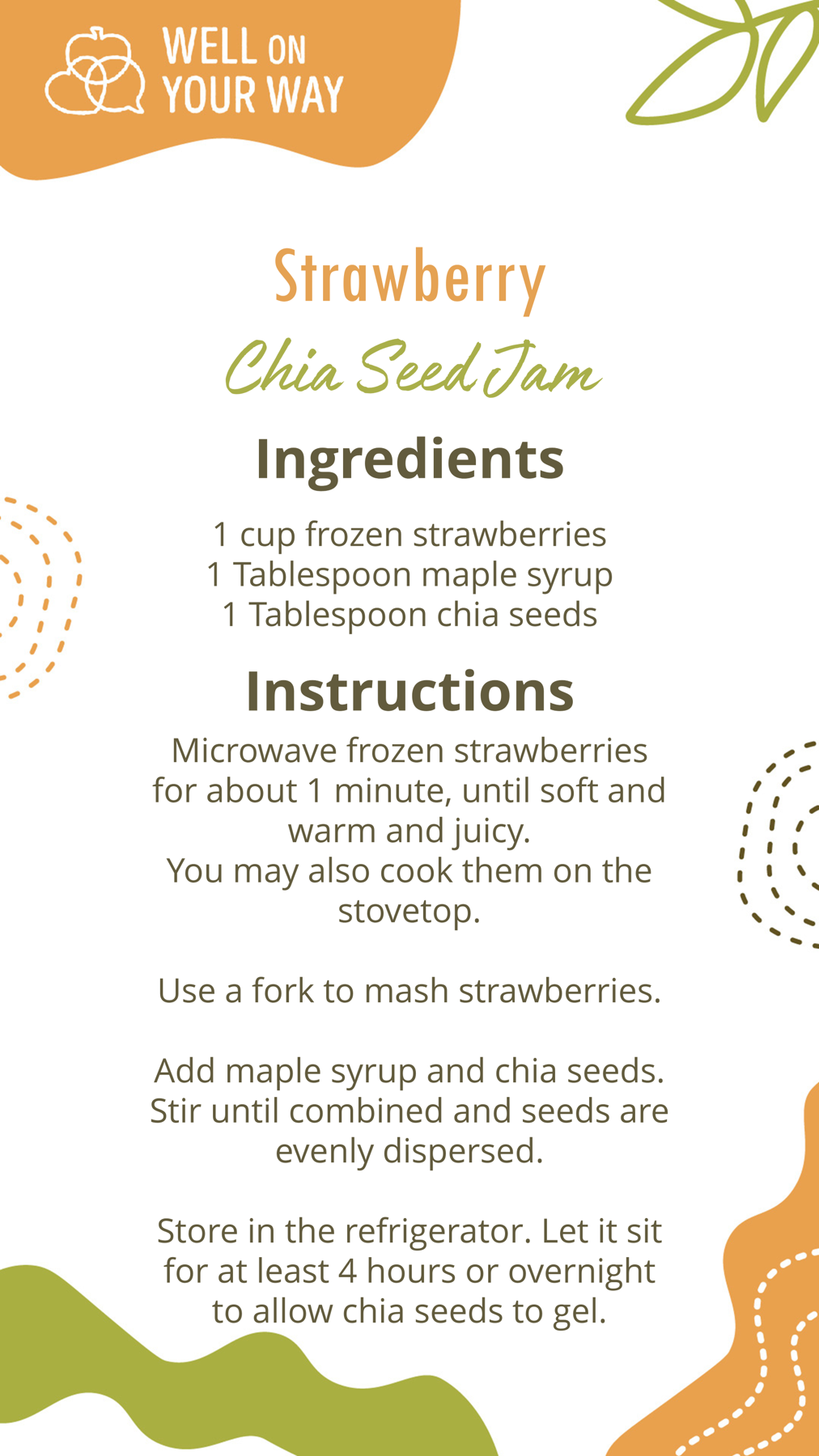
Chia jam can be prepared simply using your favorite type of frozen fruit, plus a sweetener or some lemon juice to enhance the flavor. Try it for yourself by referencing the recipe below!

Recent Posts

September 1, 2026
Grains make up one of the food groups that should be included on everyone’s plate. Grains in general are best known for being excellent sources of carbohydrates and providing our bodies with energy. But when we narrow in on this food group, we see there’s diversity among types of grains and unique nutritional benefits specific to each kind. All cereal grains technically come from the Poaceae botanical family, which encompasses many types of grasses. Grains, by definition, are the edible seeds or kernels of certain grasses. The grains food group also includes some “pseudo-grains,” which are not members of the Poaceae family, but are considered grains because they are similar in appearance, preparation and use, and nutrition. Examples of grains are wheat, oats, rice, corn, barley, millet, and sorghum. Examples of pseudo-grains are quinoa, buckwheat, and amaranth. 1,2 Grains can be classified into two categories: whole and refined. Whole grains contain all three parts of the kernel–the bran, germ, and endosperm–in their natural proportions. Refined grains are grains that have been milled to remove the bran and germ, leaving only the endosperm. The bran refers to the layers of skin on the outside of the kernel, where antioxidants, B-vitamins, and fiber are found. The germ is the embryo within the seed that has the potential to sprout into a new plant. It’s made up of B-vitamins, some protein, minerals, and healthy fats. The endosperm is the largest part of the kernel, packed with energy in the form of starchy carbohydrates and serving as the food supply for the germ when it grows into a young plant. 3